Dubai stands at the centre of global trade and logistics. The city’s world-class ports, free zones, and air freight facilities have made it a preferred hub for global supply chains. Every sector, from e-commerce and manufacturing to pharmaceuticals and FMCG, relies on efficient warehouse operations to maintain service standards and control costs.
As trade volumes grow, the focus has shifted from warehouse expansion to warehouse optimisation. This strategic approach combines technology, data, and design to extract maximum value from every square metre.
Today, warehouse optimisation in Dubai is viewed as a business necessity. It’s about designing systems that minimise material handling, reduce operational expenses, and maximise throughput. Companies are rethinking traditional warehouse management, integrating automation and analytics to create agile, high-performing logistics ecosystems. The shift reflects a broader evolution, where logistics efficiency has become central to business success and competitive advantage.
Table of Contents
The Role of Warehouse Optimisation in Modern Logistics
An optimised warehouse enhances every link in the supply chain. It improves order accuracy, reduces lead times, and ensures that materials or products are available when needed. In an economy driven by speed and service excellence, these capabilities determine how competitive a business can be.
In Dubai’s fast-moving logistics market, time and precision define business outcomes. Delays, inefficiencies, or space mismanagement can directly affect profitability and brand credibility.
An underutilised facility can lead to wasted resources, while a disorganised layout can slow operations, affecting customer satisfaction.
Hence, optimisation has become a measurable business strategy rather than an operational improvement.
Key outcomes of warehouse optimisation include:
- Reduced operational costs through streamlined workflows and minimal manual intervention.
- Better space utilisation by structuring layouts for faster picking and replenishment.
- Improved customer satisfaction through on-time deliveries and accurate dispatches.
- Enhanced scalability to manage seasonal or demand-based fluctuations.
For Dubai’s logistics-driven economy, these results translate into better competitiveness and sustainability.
Dubai’s Logistics Advantage
Dubai’s strategic position gives it unmatched connectivity to global markets. Located at the crossroads of Asia, Africa, and Europe, the emirate functions as a gateway for international trade, supported by world-class infrastructure and business-friendly regulations.
- Jebel Ali Port serves as the Middle East’s largest port, handling millions of containers annually.
- Dubai South and Al Maktoum International Airport support vast air cargo operations that enable same-day or next-day delivery for international shipments.
- Advanced road and rail networks connect industrial zones and free trade areas seamlessly, improving supply chain reliability.
Free zones like Jebel Ali Free Zone (JAFZA) and Dubai Industrial City offer modern warehousing, flexible leasing, and simplified logistics processes. These business environments attract multinational players but also increase competition among logistics providers.
To stay efficient, companies operating here must go beyond traditional setups. They must optimise every square metre and every movement within their warehouses to retain efficiency and profitability. The focus is now on integrating technology into physical operations to achieve measurable outcomes.
Key Pillars of Warehouse Optimisation
1. Strategic Warehouse Layout Planning
A well-designed layout determines how efficiently goods move through the facility. In Dubai, where land costs are high, every metre counts. Optimised layout planning focuses on:
- Clear separation between receiving, storage, and dispatch zones to prevent workflow overlap.
- Logical product placement based on movement frequency (fast-moving items positioned closer to dispatch areas).
- Smooth traffic flow for forklifts and conveyors.
- Dedicated safety lanes and ergonomic design for workers.
Well-planned layouts reduce travel time, improve accuracy, and enhance worker safety. For large logistics operators and retailers in Dubai, such design efficiency directly translates to faster deliveries, reduced handling costs, and safer work environments. The ability to reconfigure layouts easily also ensures adaptability as business volumes change.
2. Smart Storage Systems
Storage efficiency is central to optimisation. Many warehouses in Dubai now employ vertical storage, automated retrieval systems, and modular shelving to maximise capacity. High-rise pallet racks and mobile storage units make better use of cubic space instead of expanding horizontally, which is particularly valuable where land costs are premium.
Implementing smart storage reduces dependency on manual sorting. Automation can track inventory in real time, helping warehouse managers maintain accuracy and prevent overstocking or stockouts. For temperature-controlled sectors like pharmaceuticals or food distribution, advanced storage systems ensure compliance with safety standards and improve traceability.
3. Warehouse Management Systems (WMS)
A Warehouse Management System (WMS) acts as the brain of modern logistics operations. It provides real-time visibility into inventory, orders, and performance metrics, allowing businesses to manage multiple sites seamlessly.
Core functions of WMS include:
- Tracking goods from receipt to dispatch across multiple warehouse locations.
- Automating picking and replenishment tasks.
- Generating reports for productivity and storage efficiency.
- Integrating with ERP or supply chain software for better coordination.
In Dubai’s competitive logistics market, a well-implemented WMS reduces human error, improves forecasting, and enhances control across multi-location operations. It also enables data-backed decisions that support long-term optimisation strategies.
4. Automation and Robotics
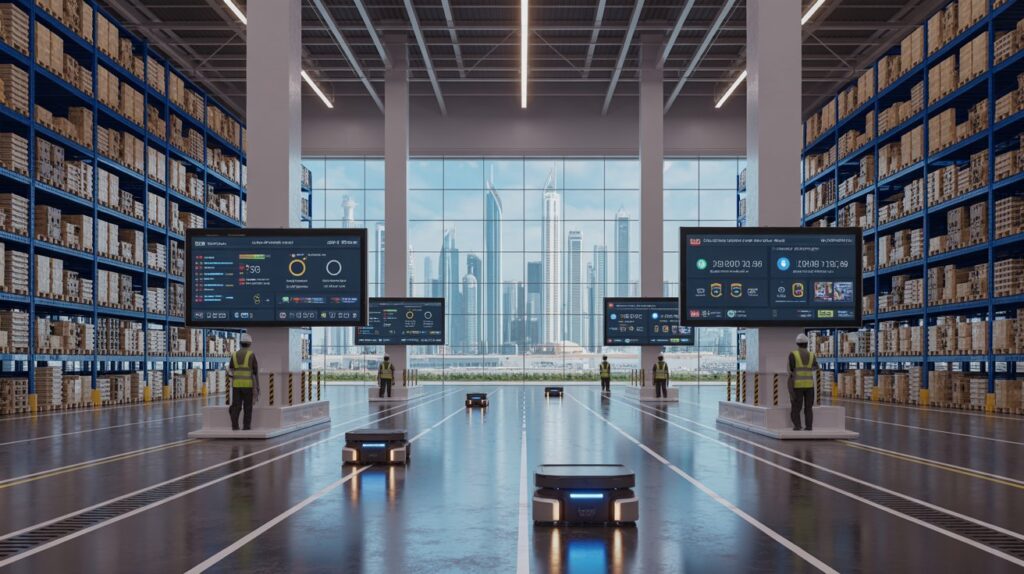
The rise of automation is transforming how warehouses function. Robotic picking systems, autonomous forklifts, and automated sorting lines are becoming increasingly common in Dubai’s logistics hubs and free zones.
Automation helps:
- Speed up repetitive tasks.
- Reduce labour dependency.
- Enhance precision in handling fragile or high-value goods.
- Maintain consistent performance even during high-demand periods.
With rising labour costs and high service demands, robotics ensures consistency in operations and faster return on investment for businesses.
5. Data-Driven Decision Making
Warehouse optimisation thrives on insights. Using data analytics allows managers to measure performance indicators such as picking speed, space utilisation, and order accuracy.
Advanced analytics tools can also predict demand patterns, helping businesses adjust inventory levels accordingly. Predictive insights minimize wastage and help align storage planning with real-time market trends, an essential advantage in Dubai’s fast-paced trade environment.
6. Sustainable Practices in Warehousing
Sustainability has become a major strategic goal in logistics. Dubai’s vision for a green economy encourages warehouses to adopt environmentally responsible designs and practices.
Examples include:
- Energy-efficient lighting and ventilation systems.
- Solar-powered operations.
- Optimised routing to reduce vehicle emissions.
- Recycling and waste reduction initiatives.
Sustainable warehouses not only lower operational costs but also strengthen a company’s environmental reputation. In Dubai, where sustainability reporting is increasingly tied to compliance and brand positioning, such practices deliver both ecological and economic benefits.
The Business Impact of Warehouse Optimisation
An optimised warehouse does more than streamline logistics; it transforms profitability and business agility. For companies operating in Dubai’s competitive sectors such as retail, FMCG, and manufacturing, warehouse performance directly influences customer satisfaction and financial outcomes.
Key business benefits include:
- Improved inventory turnover through reduced holding costs and faster replenishment cycles.
- Stronger supply chain resilience with the ability to handle disruptions or demand surges efficiently.
- Enhanced ROI through better space utilisation, reducing the need for costly expansions.
- Faster order fulfilment, leading to higher client satisfaction and stronger repeat business.
By focusing on strategic optimisation, businesses build long-term stability in a rapidly evolving logistics environment. In an economy where speed defines service, warehouse excellence becomes a defining factor for market leadership.
Technology’s Expanding Role in Dubai’s Warehousing Future
Dubai’s push toward smart city infrastructure aligns closely with its logistics evolution. The integration of IoT, AI, and machine learning into warehouse management is shaping a new generation of intelligent facilities that operate with precision and predictive capabilities.
Emerging trends include:
- IoT sensors that monitor inventory temperature, humidity, and movement in real time.
- AI-based predictive analytics that forecast demand and automate restocking.
- Cloud-based logistics management platforms connecting suppliers, warehouses, and distributors seamlessly.
- Drone-based inventory audits for faster and more accurate stock verification.
These technologies create a connected ecosystem where decisions are made faster and more precisely, setting the foundation for Dubai’s next phase of logistics leadership. The result is a smarter, more adaptive warehousing network capable of meeting the city’s global trade ambitions.
Common Challenges in Implementing Warehouse Optimisation
Despite its advantages, warehouse optimisation requires strategic planning, investment, and cultural alignment. Common challenges faced by Dubai-based businesses include:
- High upfront costs for automation and system integration.
- Shortage of skilled professionals for managing advanced warehouse technologies.
- Need for continuous process re-evaluation to stay aligned with demand shifts.
- Integration complexities between legacy systems and modern WMS platforms.
Addressing these challenges demands collaboration between construction partners, technology providers, and logistics experts. Companies that approach optimisation as a phased strategy, starting with layout improvement and progressing toward automation, achieve more sustainable results.
The Future of Warehousing in Dubai
The future of warehousing in Dubai lies in smart, adaptive systems that merge physical efficiency with digital intelligence. Warehouses will function as data-powered logistics centres capable of self-monitoring, self-correcting, and self-optimising processes.
With increasing government focus on digital transformation, companies that invest early in automation, data analytics, and sustainable infrastructure will gain the advantage. Warehouse optimisation will continue to evolve as a long-term business strategy—vital for maintaining speed, cost-efficiency, and customer trust in one of the world’s busiest logistics markets.
Conclusion
Warehouse optimisation in Dubai represents a strategic approach to achieving operational excellence. It involves using advanced systems, intelligent design, and sustainable practices to create an efficient flow of goods and information. Businesses that recognise warehouse optimisation as part of their core logistics strategy position themselves for stronger market performance, reduced costs, and sustained growth.
At Durra Altaj Contracting, we focus on creating warehouses that deliver measurable results for businesses across Dubai. Our expertise in design, construction, and optimisation enables clients to transform logistics facilities into high-performing assets that support long-term growth and efficiency. Every project is built with attention to detail, functionality, and scalability.
As the city continues to strengthen its global reputation as a logistics leader, the importance of warehouse optimisation will only deepen. Companies that collaborate with experts like Durra Altaj Contracting stand to gain facilities engineered for reliability, adaptability, and sustained success in a competitive market.