In Dubai, a warehouse floor is more than a surface to walk or drive on. It forms the backbone of logistics and storage operations.
The city’s extreme heat, high humidity, and omnipresent desert sand create unique challenges that standard flooring systems often fail to withstand.
Over time, poor flooring choices can lead to cracks, surface dusting, delamination, and costly operational downtime.
Warehouse developers and facility managers in Dubai understand that durability, load capacity, and ease of maintenance are non-negotiable.
The right flooring solution ensures smooth movement of machinery, safety for personnel, and long-term protection of the building’s structure. Selecting the most suitable system requires careful consideration of environmental factors, usage intensity, and lifecycle costs.
This guide explores the best-performing flooring systems for Dubai’s conditions, offering practical insights into materials, performance criteria, and specification strategies that deliver long-term reliability.
Table of Contents
Warehouse Flooring Solutions Built for Dubai’s Climate: Durable, Efficient, Ready
In Dubai, a warehouse floor is more than a surface to walk or drive on. It forms the backbone of logistics and storage operations.
The city’s extreme heat, high humidity, and omnipresent desert sand create unique challenges that standard flooring systems often fail to withstand.
Over time, poor flooring choices can lead to cracks, surface dusting, delamination, and costly operational downtime.
Warehouse developers and facility managers in Dubai understand that durability, load capacity, and ease of maintenance are non-negotiable.
The right flooring solution ensures smooth movement of machinery, safety for personnel, and long-term protection of the building’s structure. Selecting the most suitable system requires careful consideration of environmental factors, usage intensity, and lifecycle costs.
This guide explores the best-performing flooring systems for Dubai’s conditions, offering practical insights into materials, performance criteria, and specification strategies that deliver long-term reliability.
Understanding Dubai’s Climate and Its Impact on Warehouse Floors
Dubai’s climate demands respect. The combination of searing temperatures that often exceed 40°C, fluctuating humidity levels, and pervasive dust requires flooring materials engineered to endure constant expansion, contraction, and abrasion.
Concrete surfaces naturally expand in heat and contract at night. Without the right reinforcement or coating, this movement leads to surface cracks and joint deterioration. The fine desert sand acts like sandpaper, gradually eroding coatings and dulling polished finishes. In coastal areas, high humidity and saline air accelerate corrosion in reinforced slabs and coatings.
Additionally, operational stress compounds the challenge.
Heavy forklifts, pallet jacks, high-rack systems, and automated material handling equipment demand a floor that can maintain flatness and strength over time.
A single weak point can compromise the efficiency of an entire distribution system.
To perform well in Dubai, a warehouse floor must exhibit:
- Thermal stability: Resistance to heat-induced expansion and surface degradation.
- Mechanical durability: Ability to handle continuous traffic and heavy loads.
- Dust and abrasion resistance: Essential in sandy environments.
- Moisture tolerance: To withstand humidity and cleaning cycles.
- Low reflectivity and skid resistance: For worker safety and lighting efficiency.
Leading Warehouse Flooring Systems for Dubai
Epoxy Flooring
Epoxy is one of the most widely used flooring systems for industrial and logistics facilities in Dubai. It forms a seamless, high-strength layer that bonds with the concrete substrate, creating a dustproof, non-porous surface.
For warehouses handling chemicals, oils, or frequent cleaning, epoxy provides chemical resistance and easy wash-down capability. Its smooth finish supports rapid movement of trolleys and forklifts, reducing vibration and equipment wear.
In Dubai’s heat, UV-stable epoxy formulations are preferred to prevent discoloration and surface chalking. A proper primer and moisture barrier are also essential to control vapor pressure during the curing stage.
Ideal for:
- General storage zones
- Manufacturing and assembly areas
- High-traffic distribution corridors
Advantages:
- Seamless finish prevents dust accumulation
- Excellent compressive strength
- Chemical and abrasion resistance
- Wide range of color and texture options
Key considerations:
- Requires well-prepared substrate and controlled curing conditions
- Not ideal for thermal-shock zones or exposure to direct sunlight without UV protection
Polished Concrete Flooring
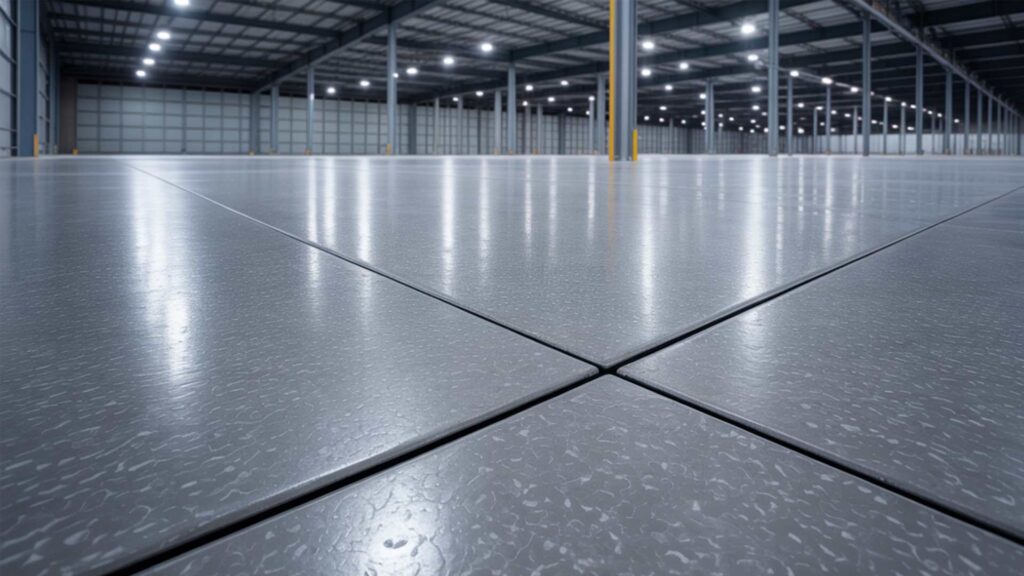
Polished concrete flooring combines strength, aesthetics, and sustainability. Instead of adding a coating, the surface of the concrete slab is mechanically ground, densified, and polished to achieve a reflective finish that enhances lighting efficiency.
In Dubai’s hot climate, polished concrete performs well because it contains no resin layers that can soften or peel. It also dissipates heat quickly and provides excellent load-bearing capacity. For facilities operating forklifts and very narrow aisle (VNA) systems, polished concrete offers the flatness and durability required for precision navigation.
Ideal for:
- High-bay warehouses
- Heavy equipment zones
- Facilities prioritizing low maintenance
Advantages:
- Long service life and minimal maintenance
- Reflective finish improves lighting efficiency
- Resistant to thermal expansion and wear
- No topcoat or resins that degrade under heat
Key considerations:
- Requires professional installation and accurate flatness control
- Surface may need periodic re-polishing depending on traffic intensity
Polyurethane (PU) Flooring
Polyurethane flooring systems deliver higher flexibility and thermal tolerance compared to epoxy. They are particularly suited for environments exposed to temperature fluctuations, wash-down operations, or humid air.
PU coatings expand and contract with the concrete substrate, preventing surface cracking. They also resist moisture penetration and thermal shock, making them ideal for cold stores, food warehouses, and coastal locations.
A variant known as PU-cement flooring combines polyurethane resin with cement and aggregates to create a highly durable surface capable of withstanding heavy loads and chemical exposure.
Ideal for:
- Cold storage and food handling areas
- Moisture-prone or coastal facilities
- Zones with cleaning or temperature cycles
Advantages:
- Excellent thermal and chemical resistance
- Flexible and shock-absorbent under mechanical stress
- Long-term color stability and low maintenance
Key considerations:
- Slightly higher material cost compared to epoxy
- Requires expert mixing and application for consistent finish
Vinyl and Rubber Flooring
Vinyl and rubber flooring systems are used in specific areas of a warehouse where aesthetics, hygiene, or comfort are priorities. For example, administrative zones, packing sections, or light-duty storage areas often benefit from vinyl flooring due to its resilience and ease of cleaning.
Rubber flooring provides slip resistance and noise reduction in zones with frequent pedestrian movement or delicate equipment handling. Both materials perform well indoors when the environment is temperature-controlled.
Ideal for:
- Light-duty storage and office zones within warehouses
- Laboratories or packaging areas
- Worker rest zones or mezzanine offices
Advantages:
- Comfortable underfoot and slip resistant
- Available in multiple finishes and patterns
- Quick installation with minimal downtime
Key considerations:
- Not suitable for heavy traffic or direct sunlight exposure
- May require adhesives rated for high ambient temperatures
Hybrid Systems and Zoning Approaches
Large-scale warehouses in Dubai often combine flooring systems to match operational zones. For instance, epoxy for main traffic aisles, polished concrete in heavy load zones, and PU in cold or moisture-prone areas.
Hybrid systems, such as epoxy base coats topped with PU finishes, enhance flexibility and thermal performance. This approach allows facility owners to align investment with zone-critical requirements, optimizing both cost and durability.
Key Factors in Selecting the Right System
Load and Traffic Intensity
The type and frequency of mechanical traffic determine surface hardness, coating thickness, and reinforcement strategy. Forklift operations, pallet storage density, and conveyor systems all influence floor selection.
For very narrow aisle configurations, surface flatness must meet strict standards like TR34 or FM2. Any deviation can affect automation precision and cause long-term structural wear.
Environmental Exposure
Warehouses in Dubai Industrial City or Jebel Ali often face high humidity and airborne dust. Facilities closer to the coast experience additional salt corrosion risk. Flooring materials should therefore include moisture barriers, UV protection, and expansion joints designed for heat-induced movement.
Maintenance Expectations
Polished concrete and PU systems require minimal upkeep, whereas epoxy floors need scheduled re-coating based on wear cycles. A well-planned maintenance routine, like cleaning, periodic inspection, and joint resealing, extends the life of the surface and prevents costly overhauls.
Cost and Lifecycle Value
Initial installation cost is only one part of the equation. Floors that fail prematurely due to poor specification can multiply expenses through repairs, downtime, and product damage. Evaluating lifecycle value, such as durability, maintenance effort, and operational efficiency, gives a true picture of ROI.
Maintenance Checklist for Dubai Warehouses
Routine Cleaning:
Use industrial sweepers and vacuum systems to remove sand and dust daily. Avoid wet cleaning on untreated concrete as moisture can lead to cracks.
Inspection Schedule:
Conduct quarterly inspections for coating wear, cracks, or joint separation. Address any defects immediately to prevent surface delamination.
Surface Reconditioning:
Depending on the flooring system, perform re-coating or polishing every few years to maintain appearance and mechanical strength.
Environmental Control:
Maintain optimal humidity levels inside the facility using ventilation systems. Limit direct sunlight on resin-based floors through shading or reflective coatings.
Preventive Design:
Install heavy-duty mats at entry points to limit sand ingress. Ensure joint fillers remain flexible to handle expansion and contraction cycles.
Sustainability and Safety Considerations
Warehouse flooring in Dubai is increasingly viewed through the lens of sustainability and worker well-being. Low-VOC materials and solvent-free coatings help maintain indoor air quality. Polished concrete, for instance, uses no external chemicals or resins and can contribute to LEED credits.
Safety features such as anti-slip aggregates, line markings, and reflective surfaces improve navigation and reduce accidents. In logistics environments that operate 24/7, these elements enhance operational rhythm and worker efficiency.
Why Expert Design and Installation Matter
Even the best materials underperform when installation standards are compromised. Flooring success depends on meticulous surface preparation, moisture testing, correct primer use, and temperature-controlled curing. Joint detailing, curing compounds, and coating thickness all determine performance longevity.
Dubai’s harsh conditions amplify these factors. Substandard mixing, rushed curing, or improper moisture sealing can cause coating bubbles, peeling, and micro-cracks within months. Engaging experienced flooring professionals ensures adherence to industry standards and optimal product lifespan.
How Dura Altaj Contracting Delivers Reliable Flooring for Dubai’s Warehouses
Behind every durable warehouse floor lies precise engineering and execution. At Dura Altaj Contracting, flooring projects are approached with the same rigor applied to full-scale industrial builds, combining technical understanding, material science, and field-tested experience.
Each flooring assignment begins with a comprehensive site assessment, covering:
- Operational dynamics: Load patterns, traffic flow, and equipment type.
- Environmental exposure: Temperature variation, humidity levels, and sand abrasion.
- Surface condition: Substrate quality, moisture presence, and leveling requirements.
Based on these factors, our team recommends flooring systems engineered for long-term performance in Dubai’s harsh climate. Every installation is supported by precision surface preparation and adherence to international standards.
Our process includes:
- Mechanical surface profiling using industrial grinders and vacuum systems for optimal coating adhesion.
- Moisture testing and vapor barrier application to prevent delamination in humid conditions.
- Layered coating systems, including primers, epoxy or PU coats, and protective sealers applied in controlled temperature environments.
- Joint detailing and finishing to ensure seamless movement of forklifts and automated systems.
To suit diverse warehouse operations, Dura Altaj Contracting also designs hybrid and zone-specific flooring systems, such as:
- Epoxy coatings for high-traffic and chemical-handling areas.
- PU-cement flooring for cold storage or moisture-prone environments.
- Polished concrete for heavy equipment and VNA (Very Narrow Aisle) zones.
- Anti-static or reflective coatings for precision manufacturing and logistics hubs.
Beyond installation, our focus remains on lifecycle value. Dura Altaj provides maintenance programs and periodic inspections to monitor coating wear, joint stability, and surface hygiene. This proactive approach minimizes downtime and extends the lifespan of every flooring system.
By combining advanced materials, local expertise, and disciplined execution, Dura Altaj Contracting ensures every warehouse floor in Dubai performs as intended: strong, safe, and built to last.
Conclusion
A warehouse floor in Dubai must endure more than mechanical stress. It must withstand an environment that tests every material to its limits. From epoxy coatings designed for durability, to polished concrete offering long-term cost efficiency, to PU systems managing thermal stress, each flooring type brings unique strengths suited to specific operational needs.
The right choice begins with understanding how climate, traffic, and maintenance expectations interact. By aligning flooring selection with the realities of Dubai’s environment, warehouse operators can safeguard productivity, safety, and long-term value.
A well-planned flooring system is not an expense. It’s an investment in operational stability and facility longevity.